

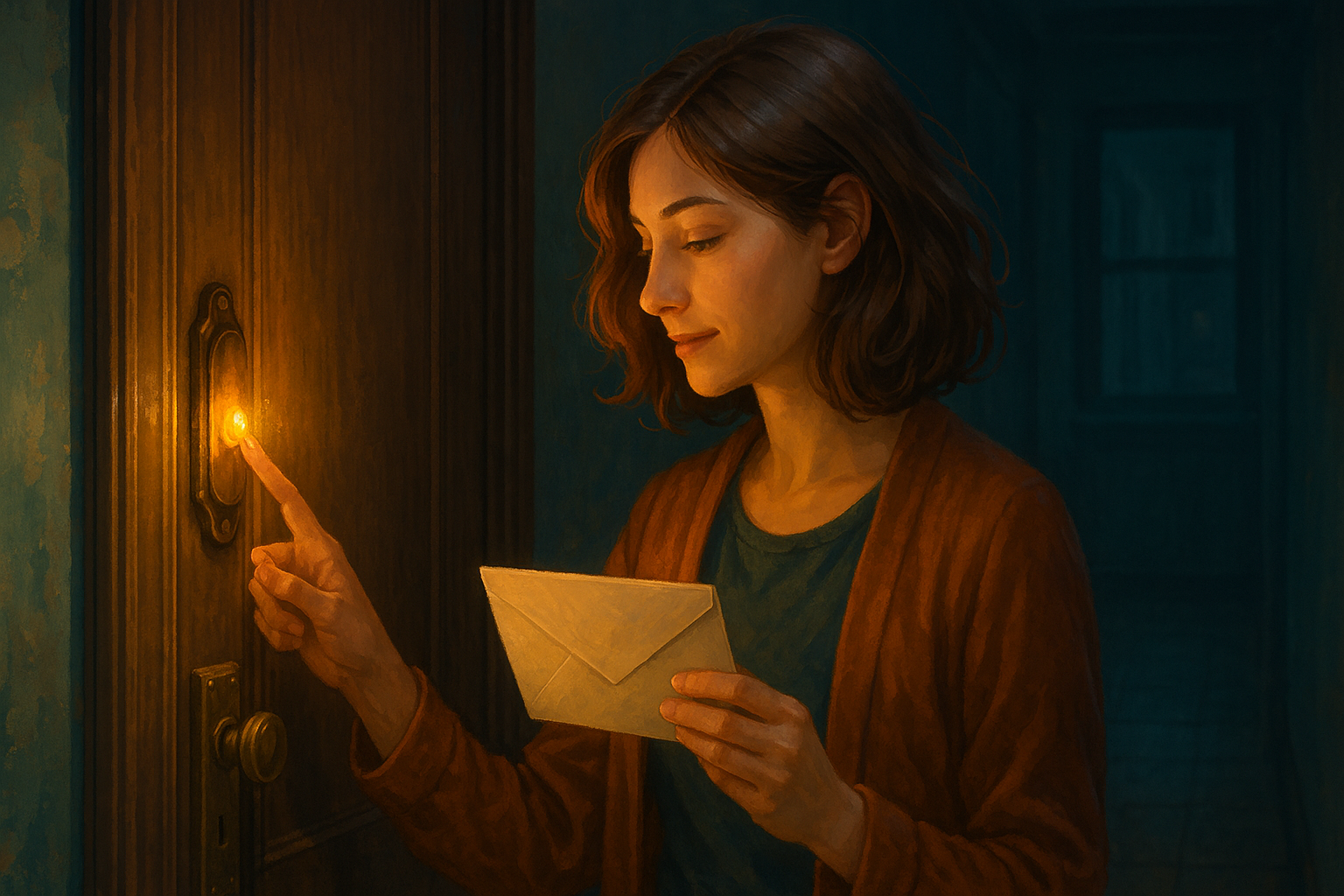
The first time the doorbell rang, Amira thought it was broken.
Not because it made a strange sound — it didn’t.
It sounded perfectly normal. Clear. Soft. A gentle, almost polite chime.
What was strange was that no one was there.
She opened the door to a quiet hallway, carpet worn thin, the faint smell of laundry detergent drifting from somewhere down the building. No footsteps. No neighbors. No delivery person vanishing down the stairs.
Just emptiness.
“Must be a glitch,” she muttered, closing it again.
But something in her chest lingered, like the echo of a note that hadn’t finished ringing.
Amira had moved into the apartment three months earlier.
Third floor. Small kitchen. A window that faced another brick wall, which she’d decorated with taped-up photos of places she hadn’t been yet: Istanbul, Seoul, Lisbon.
She called them “future corners.”
She needed them.
Because right now, life felt like a hallway with too many closed doors and no handles.
She’d left her job at a marketing firm where she had been slowly disappearing. Started freelancing instead — design, little commissions, odd projects that paid just enough to keep her floating. Not drowning. Not quite swimming either.
Every day blurred into the next.
Wake up.
Coffee.
Emails.
Hope.
Silence.
She told herself it was temporary.
She just hadn’t decided what it was temporary for.
The second time the doorbell rang, she was halfway through burning toast.
She jumped, dropping the butter knife.
Again — she opened the door immediately.
Again — empty.
This time, something had changed.
A small envelope lay on the doormat.
White. No stamp. No address. Just her name written neatly across the front.
Amira’s stomach tightened.
She knelt slowly and picked it up.
It was warm.
Not metaphorical warm.
Actually warm.
“Okay,” she whispered. “That’s new.”
She carried it inside like it might dissolve if she held it wrong.
At her kitchen table, she slid a finger under the paper seal.
Inside was a single card.
Not a letter.
Not a bill.
Not a flyer.
Just a small, sturdy piece of cream-colored cardstock.
On it, written in a familiar-but-not-familiar handwriting:
Today isn’t quiet.
It’s only building.
Amira stared.
She didn’t laugh.
She didn’t panic.
She just felt…
seen.
“Building what?” she murmured.
The card didn’t answer.
Over the next few weeks, it happened again.
Never randomly.
Never aggressively.
Only on days when her hope felt thin.
When she’d been rejected from a small job and smiled weakly at her screen.
When she saw someone else’s success online and felt something curl up behind her ribs.
When she wondered if this new life had been a mistake.
Ding.
Every time, she’d open the door.
No one there.
Only an envelope.
Always warm.
Always for her.
Each message was simple.
Something is aligning. Be patient.
You asked for change. It listens slowly.
Rest today. Tomorrow is preparing itself.
Amira never told anyone.
Not her sister.
Not her best friend.
Not her neighbor who borrowed sugar twice a week.
Some magic felt like it needed privacy to breathe.
One afternoon, she finally turned on her heel as the door closed and said aloud:
“Who are you?”
Her voice echoed slightly in the hall.
No answer.
She half-expected another envelope.
Instead, the apartment simply settled into its quiet again.
But the air felt different.
Attentive.
Amira began to notice something else.
On the days the doorbell rang, small things shifted.
A long-delayed email would suddenly arrive with an apology for the wait.
A stranger in a café would compliment her sketch and ask if she took commissions.
A former client would recommend her to a friend.
Nothing huge.
Nothing cinematic.
Just little nudges.
Little yeses.
Like someone behind the scenes was straightening the threads of her life.
The seventh envelope came on a rainy Thursday.
She hadn’t left the apartment all day.
Her laptop battery was failing.
Her bank app made her stomach hurt.
She hadn’t even bothered to make a to-do list because she already didn’t want to meet it.
Then—
Ding.
She hadn’t expected it.
Not this day.
She opened the door.
The hallway was empty again, rain-muted sounds drifting through a stairwell window.
But the envelope was there, like a patient animal.
She picked it up.
This one felt heavier.
Inside:
Tomorrow at 2:15 PM,
be at the corner café on Marlowe Street.
Bring your sketchbook.
Amira froze.
Her first instinct was to laugh.
Her second was to be annoyed.
Who did this doorbell think it was, giving her schedules?
Her third instinct… softer, quieter… was curiosity.
She set the envelope down.
Then picked it up again.
At 2:13 PM the next day, she hovered outside the café.
The sign flickered slightly.
She hadn’t been here before.
“Either this is something,” she murmured, “or I’m developing a very specific delusion.”
She went in.
The smell of espresso and cinnamon hit her immediately.
She spotted a corner seat by the window — unoccupied, sun spilling gently across the table.
She sat.
Set her sketchbook down.
Waited.
Two minutes passed.
Nothing happened.
Her shoulders began to sag.
“Of course,” she whispered. “Just when I start —”
“Amira?”
She looked up.
A woman stood there, mid-30s maybe, with gentle eyes and tired hands and a rolled-up magazine under her arm.
“Yes?” Amira answered.
“I’m Nadine,” the woman said. “I curate art for small spaces around the city — cafés, bookstores, community galleries.”
Amira’s heart stilled.
“I found your work last week,” Nadine continued. “Through an old client of yours. I just needed time to track you down.”
Time.
The same word from the cards.
“You… found me?” Amira said carefully.
Nadine smiled.
“I’ve been looking for artists whose work feels like… breathing,” she said. “Yours does. Like it was made by someone who pays attention.”
Amira swallowed hard.
“I was hoping you’d meet me here,” Nadine added. “This is where I usually meet the artists I like to work with.”
The air shifted.
Not magically.
Humanly.
“How did you know I’d come?” Amira asked quietly.
Nadine looked puzzled.
“I didn’t,” she said. “I just had a feeling you might.”
They talked.
For over an hour.
About art.
About space.
About how creativity didn’t like being rushed.
About how some things needed slow hands and soft timing.
Nadine wanted to feature Amira in a rotating art installation in local cafés.
Nothing huge.
But steady.
Paid.
Visible.
A beginning.
“You don’t have to decide now,” she said, standing. “But I think your work deserves light. And a lot of people who need it.”
When she left, Amira sat there, notebook untouched.
Breathing.
Something behind her ribs felt warmer again.
That evening, when she returned home, her doorbell rang.
Ding.
She smiled before she even stood up.
When she opened the door, another envelope waited.
Inside, just three lines:
It wasn’t good news waiting to happen.
It was you becoming ready to receive it.
We’ll ring again.
Amira laughed softly.
Not because it was funny.
Because it felt true.
From then on, the doorbell didn’t ring as often.
Not because the magic left.
Because she didn’t need it as much.
She started saying yes to things — not just jobs, but dinners, conversations, invitations.
She emailed people first instead of waiting.
She decorated her kitchen with color again.
She stopped whispering her dreams and started speaking them.
And sometimes…
On days when life felt uncertain again…
When the future went quiet…
When she forgot how far she’d already come…
Ding.
She’d open the door.
Not expecting answers.
Just gratitude.
Because she finally understood:
The doorbell was never about delivering news.
It was about reminding her
she was still moving.